

Four questions for Deepak Kashyap
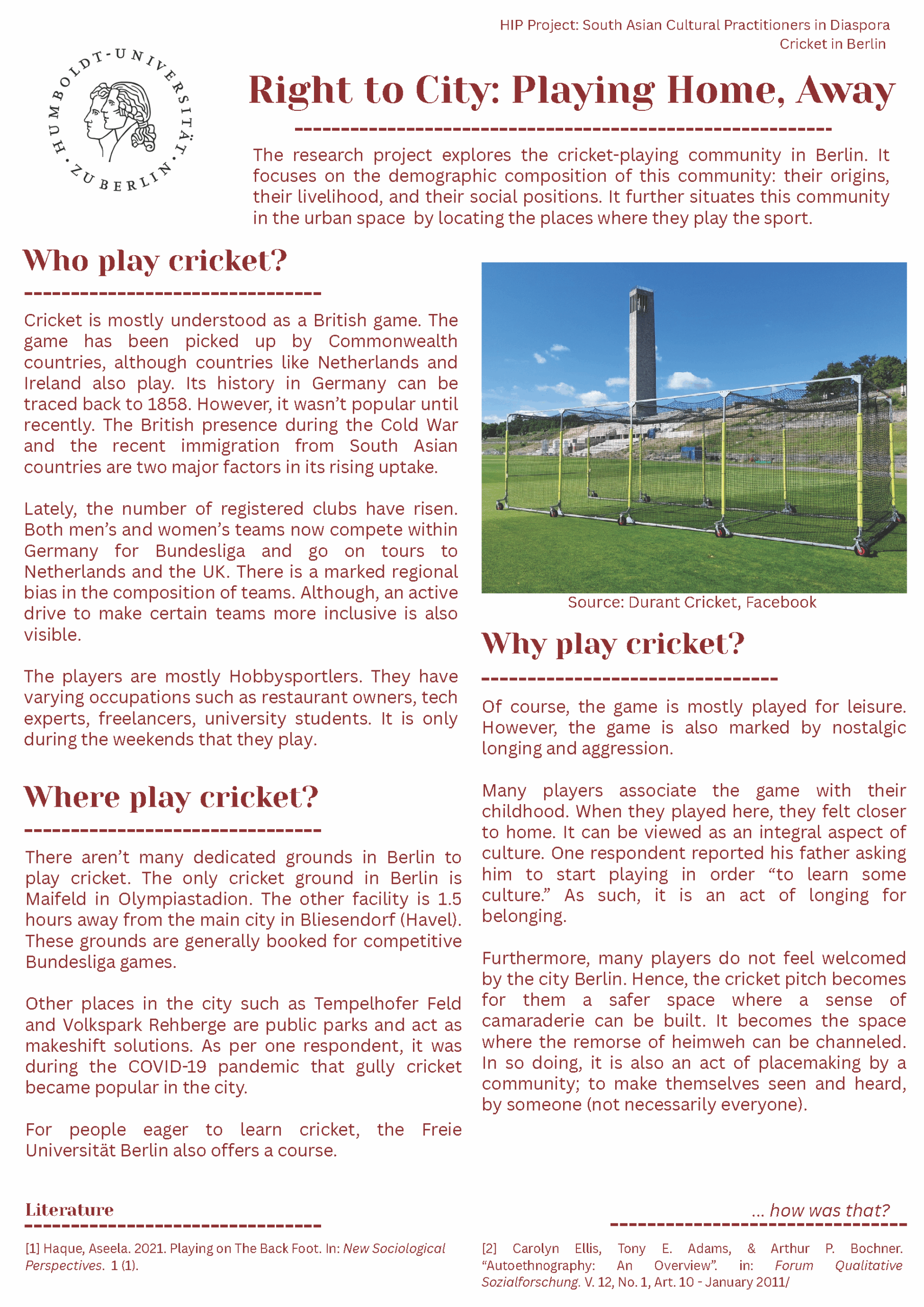
In the summer of 2025, Deepak Kashyap, a doctoral candidate from JNU, our partner university in Delhi, embarked on a three-month research internship at Humboldt-Universität zu Berlin, delving into the unexpected cricket culture flourishing in the city. In this conversation, Deepak shares how the research internship offered a structured, hands-on approach to research, blending academic rigor with meaningful cultural exchange. From exploring the unique dynamics of cricket in Berlin to reflecting on his own role as a researcher, Deepak Kashyap discusses how the experience shaped his understanding of both the sport and his academic journey.

Deepak Kashyap during a presentation of his research at Humboldt-Universität zu Berlin (c) NCS
How do you perceive your role as a research intern in comparison to being a student or doctoral candidate at the university? Do you feel that your perspective and responsibilities have shifted significantly?
In my understanding, my role as a research intern is significantly different than being a student or a doctoral student at the university. Because of the time-bound nature of the internship, it is more rigorous in terms of frequency and regularity. Having a shared office within the institute has proved immensely beneficial, especially during brainstorming sessions and mutual knowledge exchange. At the same time, I realize that being enrolled as a student at the university would have opened up more pathways for me in terms of the offered courses and diversity of friend circles. In comparison to a doctoral candidate, I find the internship more structured and focused.
Yes, there is a considerable shift in perspective and responsibilities. From my experience as a doctoral student at JNU, I can say that this internship allowed for more human interaction while doing research work. The paperwork for scholarship was not a problem with HU. The research colloquium organised monthly, combined with weekly talks, gave substantial impetus to engage with interdisciplinary work within the framework of the research project.
What inspired you to explore cricket in Berlin, and what aspects of this research topic have you found most intriguing or surprising?
The phenomenon of people playing cricket in Berlin was first mentioned during our initial rounds of presentation for the research project. I was a bit surprised on getting to know about such practice because in Europe cricket is a relatively lesser-known sport. It piqued my interest because I wanted to find out how the sport is perceived by the inhabitants of Berlin. I also wondered in which spaces is the sport being played and how the organization of cricket matches and/or leagues work.
I had only watched the sport on television and played myself as a child. This research project provided me an opportune moment to engage with sports academically and study it from a perspective of migration and diaspora studies, urban geography, and leisure studies.
What has your experience been like living and working in Berlin, and how has it influenced your understanding of cricket’s cultural significance in the city?
In terms of studying and working academically in Berlin, the experience has been emphatically wonderful. In the initial few days, I was still learning to get around in the university system. The ready availability and range of accessible books has given a rich, multidisciplinary direction to the research. The regular interaction with the work of other academics was beneficial in incorporating pertinent idea to my study. I could, at any point of time, write an email to my supervisor to address in case of concerns regarding the project.
These interactions, within and outside the department, brought to my attentions themes such as leisure, nationalism, and nostalgia, which I had been overlooking initially. Through some suggestions, I had also been able to come to view my agency and involvement in the project. This adds an autobiographical layer to the project where I am not a non-participating outsider.
Personally, the various amenities offered by the university such as the MensaCard, Deutschlandticket, and free NextBike services made getting around the city easier.
What is the question you’ve found yourself reflecting on most during your three-month research internship at HU Berlin?
The most pressing work-related question that I had during my stay in Berlin was how could my study help the cricket-playing community in Berlin. Currently, the infrastructure in the city for cricket is quite inadequate. If I could in any way bring the benefits of my study in the real world and somehow contribute to improve the game in Berlin, it could really go a long way.
(the questions were asked by Nadja-Christina Schneider)
Four questions for Arya Lovekar
In the heart of Berlin’s vibrant and multifaceted food scene, South Asian chefs and culinary practitioners play a key role in navigating the complex web of cultural practice and mediation. As part of the Humboldt Internship Program, Arya Lovekar embarked on a journey to explore the ways in which food, as both an everyday necessity and cultural practice, bridges divides within the South Asian diaspora in Berlin. Arya’s research investigates how Indian and South Asian chefs construct cultural identities through food in response to both the diverse Berlin environment and the expectations of their various customer groups. In this conversation, Arya shares experiences, challenges and insights, shedding light on the role of food in cultural representation, identity-building and community cohesion across the diasporic landscape.

Arya Lovekar during a research presentation at Humboldt-Universität zu Berlin (c) NCS
As a research intern, how do you view your role within the research process in comparison to that of an MA student? Have your responsibilities and your perspective on the university evolved throughout the course of your internship?
As a research intern, I had much more flexibility in my research than as an MA student, where I am more limited by the disciplinary boundaries of my degree program. For the research internship, I was able to use multiple disciplinary lenses where applicable, and I found this very useful when designing the methodology of the project. Meeting other researchers at various levels in their careers has also helped me understand how I and the work I am interested in might fit into a university structure. Working as part of a larger project was a useful guideline, and it helped focus my work.
What inspired you to focus your research on chefs and restaurants in Berlin, and how do you see their role in bridging cultural gaps through food?
My brief time working in an Indian restaurant and the experience of cooking for myself and others as a migrant to Belgium made me think a lot about how food can connect or divide people, within and across communities that are uniquely imagined by every person in the group. I wanted to focus on chefs and restaurants partly because they are methodologically easier to access than people’s food practices in their homes, but also because restaurants are a site for discussing and sharing food with those who may be unfamiliar with it. When restaurants present food to their customers, they are constructing an image of their claimed culture and the wants of their customer base, and this means that it is not only food that is conveyed, but notions of how a people engages in this most mundane and everyday activity of eating. The image of a community can be built for supposed insiders and outsiders in such a setting, and many cultural tensions contribute to the construction of this image, all through food, which is not merely sustenance but an active cultural practice.
What insights have you gained about the diversity of food cultures in Berlin, and how does the city’s pluricultural environment shape the way Indian and South Asian chefs tailor their dishes to different customer groups?
I have learned that diaspora carry their social beliefs with them in a new country and express them through their food, and that there is a contradiction between the diversity and uniformity of food cultures in Berlin. Although there are many food cultures here, each one is often internally uniform, prioritising certain sections of the diaspora even from the same part of the world. As a result, when those not from South Asia eat South Asian food in Berlin, they are learning about a very carefully constructed image of South Asia. This image has been constructed with reference to social divides within South Asian, but also with the aim of sanitising and re-writing South Asia for a ‘Western’ audience, indicating a type of contemporary self-Orientalising. South Asian food benefits from Berlin’s culture of veganism and restaurants that serve South Asian food often underline that vegan and vegetarian food appears frequently in the standard fare from this part of the world.

What question has most frequently shaped your thinking during your research, and how has your perspective on the role of chefs in Berlin evolved throughout your internship?
I have been trying to understand what the ‘right’ way is for a South Asian migrant to construct themselves in the public eye in Berlin. Each migrant I have spoken to has made their own self-image to cater to so many different social tensions, and this aligns with my own experience as a migrant in Belgium and now in Berlin.
I started out seeing chefs in Berlin as somewhat romanticised figures, bringing their heritage with them and starting restaurants out of a love for food and cultural exchange. While I expected to see some deviations from this, I had not realised that much of this narrative comes from the public image of specific restaurants who wish to (truthfully or not) present themselves in this way. I found it more useful to think of the restaurant as a whole as a cultural practitioner, with all the individuals who work there entering this setting with their own reasons for participating in this cultural practice.
I enjoyed my conversations with restaurant managers, cooks, and waiters during this project, as well as with migrants not in the restaurant industry but with interesting relationships with what they perceived as “their” food. I unexpectedly spoke at length with a bookstore owner about the experience of being a migrant and eating with others. I learned that speaking in Hindi will get me further in these con-versations than English will. I learned that some people are more suspicious of people asking
questions as I did, while others are happy to tell me startling things I did not ask about, but nevertheless found fascinating.
It turns out that it is possible to find both connection and great loneliness in these
conversations, and sometimes both at once. I think there is a lot more to learn here, and more very interesting people I hope to talk to about this in the future.
(the questions were asked by Nadja-Christina Schneider)