
Four questions for Deepak Kashyap
In the summer of 2025, Deepak Kashyap, a doctoral candidate from JNU, our partner university in Delhi, embarked on a three-month research internship at Humboldt-Universität zu Berlin, delving into the unexpected cricket culture flourishing in the city. In this conversation, Deepak shares how the research internship offered a structured, hands-on approach to research, blending academic rigor with meaningful cultural exchange. From exploring the unique dynamics of cricket in Berlin to reflecting on his own role as a researcher, Deepak Kashyap discusses how the experience shaped his understanding of both the sport and his academic journey.

Deepak Kashyap during a presentation of his research at Humboldt-Universität zu Berlin (c) NCS
How do you perceive your role as a research intern in comparison to being a student or doctoral candidate at the university? Do you feel that your perspective and responsibilities have shifted significantly?
In my understanding, my role as a research intern is significantly different than being a student or a doctoral student at the university. Because of the time-bound nature of the internship, it is more rigorous in terms of frequency and regularity. Having a shared office within the institute has proved immensely beneficial, especially during brainstorming sessions and mutual knowledge exchange. At the same time, I realize that being enrolled as a student at the university would have opened up more pathways for me in terms of the offered courses and diversity of friend circles. In comparison to a doctoral candidate, I find the internship more structured and focused.
Yes, there is a considerable shift in perspective and responsibilities. From my experience as a doctoral student at JNU, I can say that this internship allowed for more human interaction while doing research work. The paperwork for scholarship was not a problem with HU. The research colloquium organised monthly, combined with weekly talks, gave substantial impetus to engage with interdisciplinary work within the framework of the research project.
What inspired you to explore cricket in Berlin, and what aspects of this research topic have you found most intriguing or surprising?
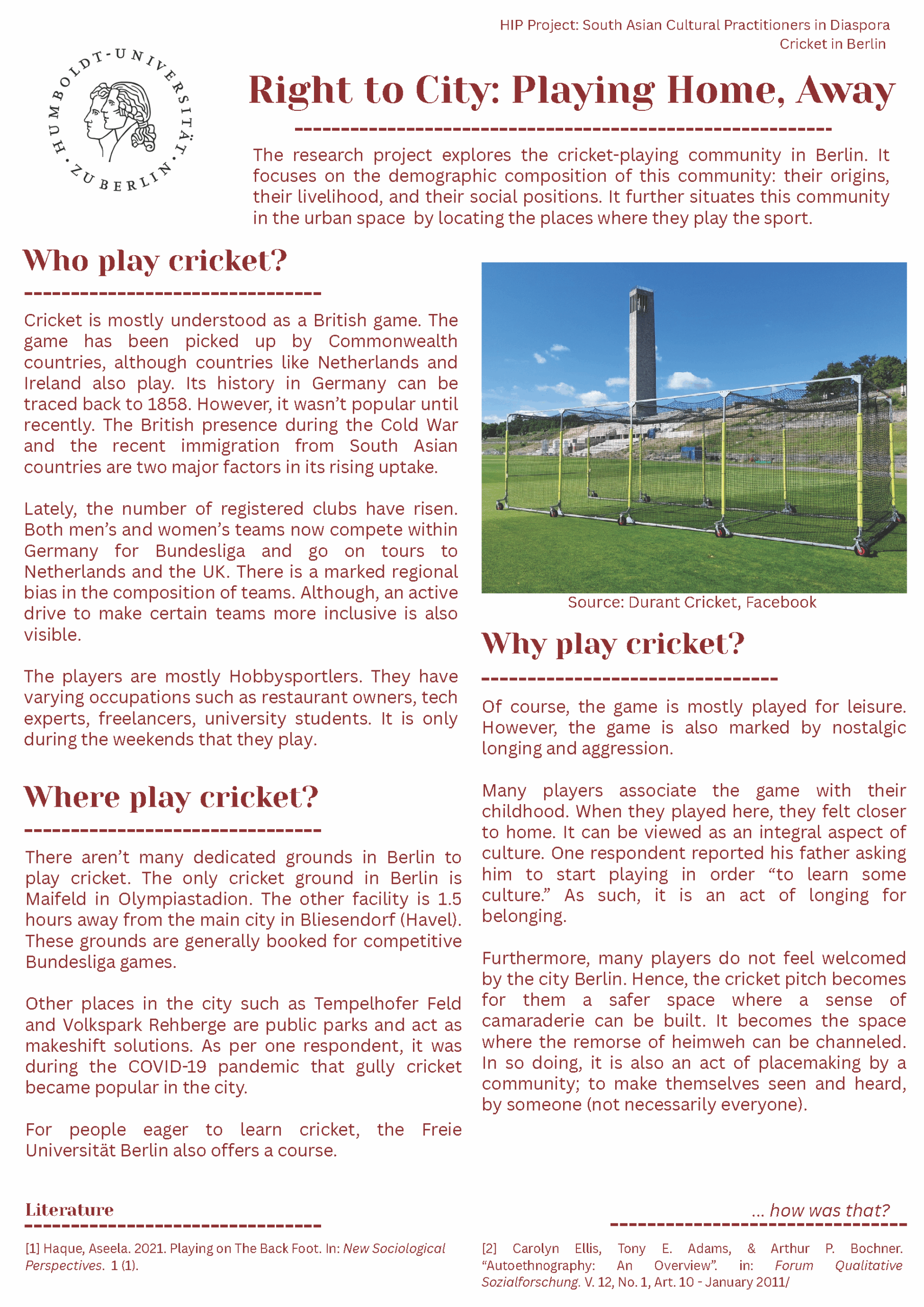
The phenomenon of people playing cricket in Berlin was first mentioned during our initial rounds of presentation for the research project. I was a bit surprised on getting to know about such practice because in Europe cricket is a relatively lesser-known sport. It piqued my interest because I wanted to find out how the sport is perceived by the inhabitants of Berlin. I also wondered in which spaces is the sport being played and how the organization of cricket matches and/or leagues work.
I had only watched the sport on television and played myself as a child. This research project provided me an opportune moment to engage with sports academically and study it from a perspective of migration and diaspora studies, urban geography, and leisure studies.
What has your experience been like living and working in Berlin, and how has it influenced your understanding of cricket’s cultural significance in the city?
In terms of studying and working academically in Berlin, the experience has been emphatically wonderful. In the initial few days, I was still learning to get around in the university system. The ready availability and range of accessible books has given a rich, multidisciplinary direction to the research. The regular interaction with the work of other academics was beneficial in incorporating pertinent idea to my study. I could, at any point of time, write an email to my supervisor to address in case of concerns regarding the project.
These interactions, within and outside the department, brought to my attentions themes such as leisure, nationalism, and nostalgia, which I had been overlooking initially. Through some suggestions, I had also been able to come to view my agency and involvement in the project. This adds an autobiographical layer to the project where I am not a non-participating outsider.
Personally, the various amenities offered by the university such as the MensaCard, Deutschlandticket, and free NextBike services made getting around the city easier.
What is the question you’ve found yourself reflecting on most during your three-month research internship at HU Berlin?
The most pressing work-related question that I had during my stay in Berlin was how could my study help the cricket-playing community in Berlin. Currently, the infrastructure in the city for cricket is quite inadequate. If I could in any way bring the benefits of my study in the real world and somehow contribute to improve the game in Berlin, it could really go a long way.
(the questions were asked by Nadja-Christina Schneider)