

Anna Lena Menne, Makēda Gershenson & Alissa Steer
Have you ever genuinely stopped to consider how Information and Communication Technology (ICT) affects your life quality? While ICT, such as smartphones and the internet, are omnipresent in our daily routines, many of us fail to truly comprehend their impact on our social reality. As such, ICT remains an enigma or a so-called “black box” to many. However, the reality is that ICTs are not impartial entities. They are products of powerful individuals who bring their own values and biases to their creation and therefore perpetuate social inequality and reinforce historical structures, such as colonial dependencies. As a result, socially privileged individuals tend to reap more benefits from digitization, while marginalized groups are often left at a disadvantage. To make matters worse, personalized tech devices and content are tailored to individual preferences, but the power dynamics within the networked systems that govern other devices remain hidden. Altogether, these issues pose a universal challenge – how can we all freely and safely navigate the digital world with self-determination?
Digital Positionality and Epistemic Justice in the Digital Age
The digital age is rife with inequalities that hinder our ability to achieve true emancipation. Epistemic inequality, which manifests as knowledge gaps between individuals and between ICT creators and regular netizens, only exacerbates this issue. Our research tutorial is an innovative solution to address these knowledge gaps head-on. X-Tutorials are a type of research tutorial facilitated by the Berlin University Alliance, led by students for students, that provide an opportunity to experiment, develop, analyze, research, or evaluate self-organized projects with other like-minded individuals. Our group, linked to the department of Gender and Media Studies for the South Asian Region (GAMS) at the Institute for Asian and African Studies (IAAW) at Humboldt-Universität zu Berlin, is committed to promoting epistemic justice, a goal that we aim to achieve by introducing the concept of digital positionality.
Digital Positionality refers to the unique online environments of individual users and how they impact life opportunities. When engaging with ICT, our social identity and position shape the challenges and opportunities we face as we navigate our lives in a digital age. The ultimate objective of our research tutorial is to affect change at both the individual and systemic levels by designing a tool that empowers individuals to reflect on their digital positionality. This way, we hope to transform our digital experiences and those of others, fostering a more just and equitable digital world.
From Accessibility to Empowerment: Action, Collaboration, and Student Research
When it came to designing our tool, we knew that we could not simply impose our own ideas on others. Instead, we needed to gain a deeper understanding of people’s diverse digital experiences to create design principles that would be truly effective. To do this, we asked ourselves a crucial question: how can we make the concept of digital positionality accessible and meaningful to netizens, who often encounter complex technological structures through highly individualized interfaces and are sometimes misled by myths surrounding technology’s rationality? This was the key challenge we tackled in our project, inspired by a Participatory Action Learning and Action Research (PALAR) approach emphasizing collaboration and critical thinking.
Our journey began in the winter semester of 2022 at the IAAW Institute and will continue into the current summer semester of 2023. In an action learning group comprised of diverse student netizens, we sought to address the research problem that directly affects us in order to improve the digital experiences of ourselves and others. Rather than presuming to know what is best, we approached the project with open minds and in adherence to the design justice network principles, we prioritized listening to and understanding individual experiences. PALAR differs from traditional research approaches, which emphasize validity and reliability. Instead, we measure our research quality by the transformative effect of the project and consider all interactions towards achieving the project goal as data. These interactions include group meetings, field discussions, participatory strategies, and reflective journals kept by group members, all of which aim to ensure ethical conduct and personal transformation. By using this approach, we aspire to design a tool that truly reflects the needs and experiences of diverse people.
In October 2022, we initiated a cyclical action research process. Our work started with exploring the theoretical foundations of digital positionality and then examining and reflecting on our own experiences with ICT and digital positionality. To better understand the experiences of individuals from diverse and often underrepresented backgrounds, we developed research methods that were inclusive and responsive to their needs. Although our project was limited in scope due to the constraints of our university course, we evaluate its success based on the principles of PALAR. In other words, we measure the extent to which our work has empowered us as student researchers, the individuals with whom we have interacted throughout the research process, and ultimately the success of the tool we plan to create in the summer semester.
Fieldwork: Exploring Diverse Digital Positionalities
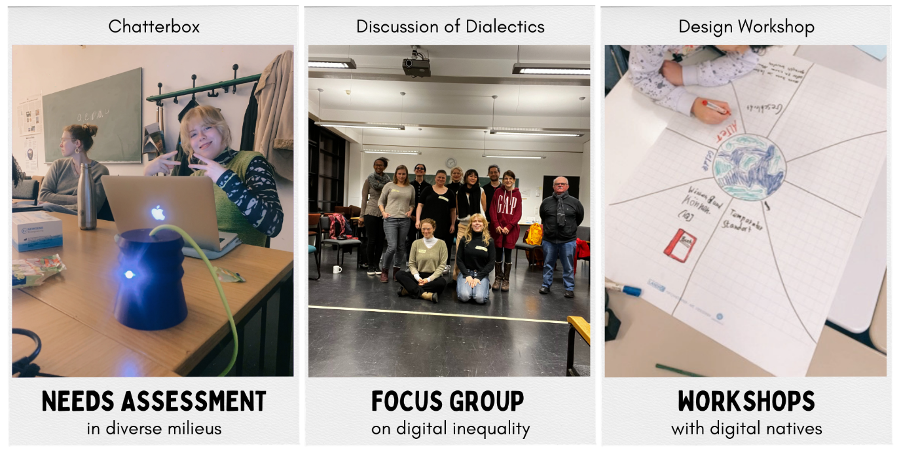
We embarked on an extensive fieldwork phase in January 2023. Our first method of inquiry was the Chatterbox, an electronic can phone developed by the Design Research Lab in Berlin, which enabled us to digitally gather and process ideas, questions, and comments on the digital sphere. With the help of a computer voice named Hans, our correspondent of the digital sphere, we interviewed approximately 60 individuals from various social milieus around Berlin, including a university and a workplace for people with disabilities, to assess their needs in reflecting on their digital positionality. We then conducted a focus group discussion with seven individuals from diverse positions in the social hierarchy, ranging in age from 24 to 72, with different identities, physical and mental abilities, and social classes, using a combination of spectrum and open-ended questions to explore issues of digital inequality and identify similarities and differences in their digital positionalities. Lastly, we organized two creative workshops for digital natives aged 11 to 14 at a community school in Berlin, teaching them about ICT and providing them with a space to reflect on their own experiences in the digital world.
Berliners‘ Perceptions of the Digital World: Beyond Established Discourses
Our conversations with people in Berlin revealed that the dominant European media discourse about the digital world significantly influenced their perspectives. Their concerns reflected issues like losing face-to-face interactions, excessive reliance on technology, addiction, and cyberbullying. They also expressed apprehensions about surveillance, data privacy, and the excessive power of large corporations in the digital realm. At the same time, the positive aspects of ICT were framed in terms of efficiency and rationality. Thus, to facilitate a more nuanced understanding of people’s relationship with digital technology beyond established discourses, our project requires an interactive educational component that emphasizes both ICT’s positive and negative aspects. Additionally, we envision the tool as open-source and easily accessible, emphasizing personal reflection and self-awareness and providing users with independent guidance to navigate the reflective process.
Avoiding Self-Reflection: The Cycle of Technology Use and Shame
People are heavily reliant on ICT, and they consider it a vital aspect of their daily lives. However, they tend to view technology’s benefits in terms of simplicity, convenience, or even laziness, rather than reflecting on how it enhances their quality of life. Although the European discourse agenda has raised awareness about the negative effects of ICT, most people continue to use it without engaging in genuine critical reflection. This, as we observed, leads to feelings of guilt and a perceived loss of self-efficacy among participants. During our focus group discussion, individuals acknowledged their high dependence on ICT with a negative connotation but were hesitant to delve into why. Instead, many devised rationalizations for their behavior, thereby bypassing self-reflection. This cycle of avoidance perpetuates the passive use and development of technology without addressing its adverse effects.
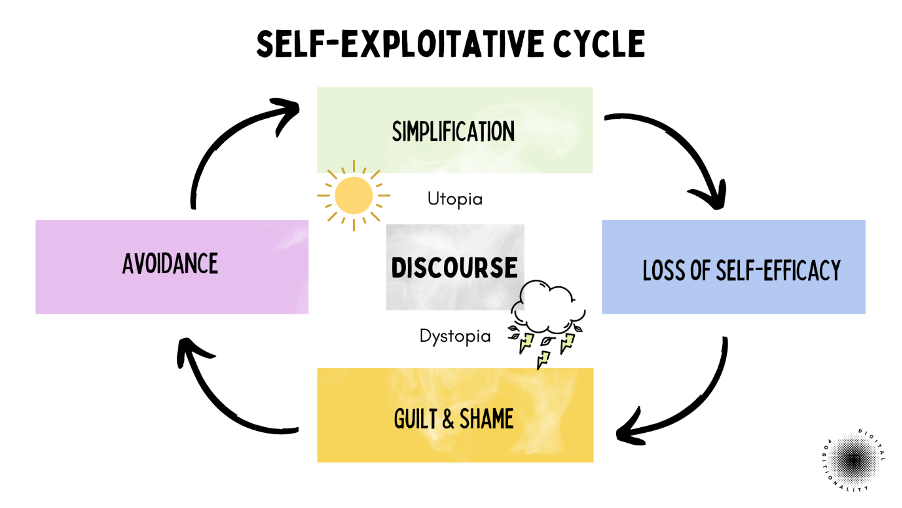
Some common ways that Berlin participants avoided reflecting on their ICT use and alleviated guilt and shame: acknowledging their dependence, but feeling too entrenched in it to break free, downplaying the negative aspects of technology, finding comfort in hearing that others share similar experiences, and even experiencing withdrawal symptoms when separated from their devices. There are numerous issues with this behavior of ours, but to highlight the most straightforward one: humans are the creators of technology, which means we have the ability to shape it to benefit us rather than just accepting the negative consequences as unavoidable. Taking the cycle displayed above one step further, we could compare it to psychological patterns of addiction. To address these issues, our tool must provide a reflective journey that is fun, creative, and affectively, emotionally, and behaviorally engaging. It should also help individuals identify self-exploitative dynamics and offer ways to maintain and heal throughout this reflective transformation while encouraging personalized self-assessment through shared socio-digital experiences.
The Transformative Potential of Shared Digital Experiences
The importance of shared experiences in our highly personalized digital world was a crucial factor in unlocking the transformative potential of our research project. Our primary goal was to gauge the effectiveness of our research by measuring the transformation of both our research group and the individuals we engaged with. We found ourselves and our participants expressing their gratitude, feeling empowered, and sharing their insights with their social networks as a result of engaging with our research, which was one of our greatest successes so far. Our focus group discussion further emphasized the importance of acknowledging the digital experiences of others, as demonstrated by a participant who found voice control on their phone annoying but recognized its significance for a blind person:
“For them (points to a blind person), it’s natural that voice control is better than for me. I’m currently struggling to… how can I explain it… understand these different perspectives. What is very annoying for me is important for others.” Therefore, our tool should promote engagement with various perspectives. It should also encourage sustainable digital self-determination by fostering creativity and providing resources for individual and collective societal transformation in the digital age. Most importantly, it should remain open to new ideas and continuously evolve through user input.
Fostering Sustainable Digital Self-Determination: Ten Principles for a Reflexivity Tool
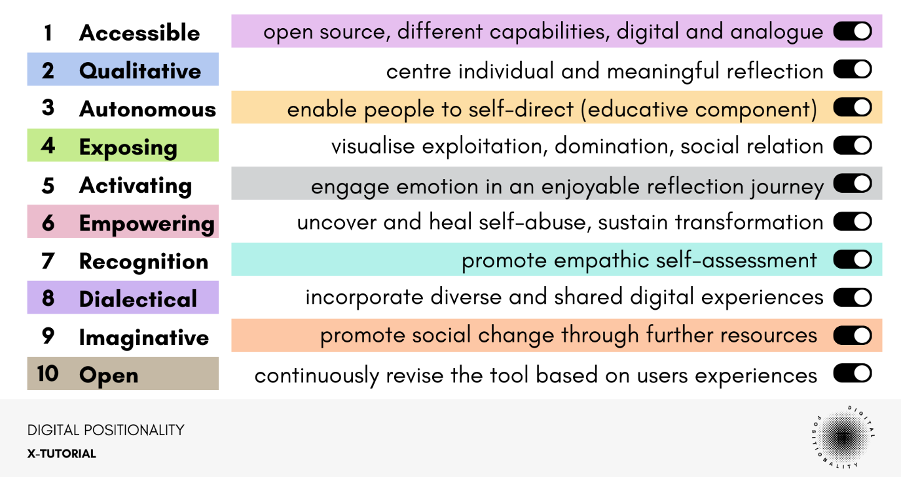
Going forward, we will focus on these ten principles in the final X-Tutorial semester at Humboldt University to create a reflexivity tool that will support our pursuit of epistemic justice and contribute to important conversations about ethics and social justice in the digital age. If you have any inquiries, want to join us or wish to contact us for another reason, please feel free to reach out.
About the authors:
Anna Lena Menne is a Master’s student at Humboldt-Universität zu Berlin, where she tutors and co-researches digital positionality. Her critical research explores global transformation processes, focusing on digitization and the historical context of information societies’ epistemology/ontology and contemporary configurations of domination, order, and inequality. She completed her Bachelors’ in Media and Communications from Freie Universität Berlin and spent a partner semester at the University of Pretoria and Chulalongkorn University in Bangkok. Contact
Makēda Gershenson is a co-researcher of digital positionality. She is a Master’s candidate in the Futures Research program at Freie Universität. She holds Bachelor’s degrees in Psychology and German Studies as well as a Master’s degree in Education from Stanford University, in addition to an Executive MBA from Quantic School of Technology. Her work focuses on emotional intelligence, equity and community-based interventions, bringing contemplative practices into educational settings. She trains school leaders, educators and organizations in social-emotional learning and mindfulness and supports individuals as a digital behavioral coach. Contact
Alissa Steer is a co-researcher of digital positionality. She is doing her master’s degree in Media and Political Communication at Freie Universität Berlin. Her research focuses on critical theory, platforms, and hegemony. She is a student assistant in the research group Politics of Digitalization at the Berlin Social Science Center. Here, she combines her experience from her Bachelor’s degree in Media Research from Technische Universität Dresden and a semester at Universitat Abat Olibat Barcelona with her research interest in the impact of patriarchy, imperialism and capitalism in the digital age. Contact
„Crouching Tigers and Invisible Dragons: Representation of Desi Chinese in Indian Popular Cinema“
by Nadja-Christina Schneider
Lawrence Liang, professor of law at Dr. Ambedkar University Delhi, is well known as an academic, public intellectual and activist who has worked on issues such as Intellectual Property, Law and Public Culture, Free Speech as well as Media and Technology. However, he has hardly spoken publicly about the Indian Chinese or Desi Chinese community, to which Liang himself belongs. The thematic focus of this year’s Mother Language Day event on ‚Transcultural Encounters with Chinese communities, languages and cultures in Asia and Africa‘ on February 21, 2023 offered him a framework to speak for the first time on the topic of representation of Desi Chinese in post-independent Indian cinema.
In his fascinating lecture, which was supplemented by very interesting film stills and clips, Liang first gave an overview of more than seven decades of post-Independence film history, which is predominantly characterized by an absence or highly stereotypical representations of Indian Chinese. Absence also in the sense that Indian Chinese characters were rarely played by members of this community. If the question of representation were to be limited solely to the portrayal of individual characters, Liang argues, then this story would quickly come to an end. Much more interesting for him, therefore, is the question what the films reveal about the coexistence and historical context in which they are set or which the film plot addresses.

Feature films shot in the 1950s in particular, whose plots are set in earlier decades, convey much about a degree of mobility that viewers obviously took for granted as something which existed at the time between the port cities and adjacent regions of the Bay of Bengal, as well as a related form of cosmopolitanism in Indian cities, which was finally brought to an end by the establishment of nation-state borders after the end of the British Raj. As a film which, just a few years before the Sino-Indian Border War of 1962, shows a form of friendly bonding and solidarity beyond gender, caste, class, and ethnic boundaries in 1930s Bengal as a possibility, Mrinal Sen’s film Neel Akasher Neechey (Under the Blue Sky, 1959) stands out. It is also remembered today as the first film in independent India to fall victim to censorship:
Only many decades later, more precisely in the feature film Tubelight (dir. Kabir Khan), released in 2017 and set at the time of the 1962 war, Lawrence Liang again sees another rare film moment in Indian cinema that gives space to the idea of friendship and solidarity with the Indian Chinese. This time perhaps also motivated by a Chinese film market which is extremely promising for Indian films, and according to media reports in India was one of the reasons for casting Chinese actress Zhu Zhu in the female lead role.
Several years were to pass again before the episode Mumbai Dragon (dir. Vishal Bhardwaj) in the anthology Modern Love Mumbai (2022), streamed on Amazon Prime, also created a cinematic opportunity for the first time to make the long-taboo subject of the internment of three thousand Desi Chinese in the prison camp in Deoli in Rajasthan discussable. Singer, actor and presenter Meiyang Chang, who in this episode plays the role of a young man whose mother can only gradually adjust to his relationship with a young Gujarati woman, made an important statement when he publicly spoke out against cases of racial discrimination to which members of marginalized communities in India were particularly exposed during the Corona pandemic.

Together with his sister Jennifer Liang, Vidura Jang Bahadur, Jenny Pinto and Koel Chatterjee, Lawrence Liang has created the remarkable online archive Desi Chinese Project, which is an important knowledge resource on the long history and present of Desi Chinese in India. As Lawrence Liang mentioned in the discussion after his insightful talk, he hopes that this archive can eventually be adopted and continued by the whole community.
von Emily Engler
Die chinesische Social Media Plattform TikTok wuchs in den letzten Jahren zu einer der umsatzstärksten Apps heran (Quelle: Datareportal, 2020). 2014 wurde die App von Luyu Yang und Alex Zhu unter den Namen Musical.ly auf den Markt gebracht, damals noch als Tool, um 15-sekündige Lip-Sync-Clips aufzunehmen, zu bearbeiten und zu teilen. Im August 2018 löste die App TikTok (Douyin (chinesisch 抖音短视频) Musical.ly ab. Der Content veränderte sich, die Inhalte der Videoclips auf TikTok hatten nun nicht zwangsläufig etwas mit Musik zu tun, auch andere Inhalte wurden vermehrt produziert und geteilt.

Die Zielgruppe TikToks ist jedoch mit der von Musical.ly gleichgeblieben, die meisten User*innen sind aus der Generation Z. (Quelle:Globalwebindex, 2019).TikTok ist leicht zu bedienen, Inhalte sind aufgrund der Länge von 15 Sekunden schnell zu erstellen, zu konsumieren und zu teilen, was zu dem Erfolg ebenfalls beiträgt. Im Jahr 2021 konnte die Betreiber*innen ganze 58 Milliarden Dollar verzeichnen (Quelle: Reuters) – und das trotz strenger Regulierungen, die von der chinesischen Regierung ausgingen. Die Möglichkeit, endlos zu scrollen, in Kombination mit einem smarten Algorithmus, der User*innen immer weitere spannende Inhalte präsentiert, funktionierte schon auf Plattformen wie Instagram. Die Videofunktion von TikTok ist jedoch bei der jungen Zielgruppe so beliebt, dass selbst die Mega-Plattformen Instagram und Youtube diese in ihren Reels und Shorts nachahmen.
Dennoch gibt es seit Release der App immer wieder Negativschlagzeilen. TikTok stand mehrfach in Kritik, nicht genug Jugend- und Datenschutz zu bieten. Nach einer Sammelklage im Dezember 2019, eingereicht von einer Gruppe Eltern, die den mangelnden Datenschutz von Minderjährigen anklagten, musste TikTok 5,7 Millionen US-Dollar Strafe zahlen (Quelle: heise online) . Expert*innen sehen die Platform kritisch – leicht beeinflussbare Kinder und Jugendliche bekommen oft Inhalte angezeigt, die ihrer mentalen Gesundheit schaden können. Kritisiert wird auch, dass sexistische Kommentare und Cybermobbing nicht streng genug behandelt werden. Dabei hat die Plattform strenge Richtlinien – die Zensur findet nur oft an anderen Stellen satt. Nachdem TikTok immer wieder politische Inhalte wie etwa Aufnahmen von den Protesten in Hong Kong verboten hat, wurde auch immer mehr Begriffe zensiert, sodass man diese nicht in Kommentare schreiben kann und nicht als Hashtags und Suchbegriffe verwenden kann. Zusätzlich gibt es länderspezifische Regeln mit Worten und Themen, die nicht kritisiert werden dürfen – in der Türkei beispielsweise Präsident Erdoğan. Der bekannteste Fall war jedoch die Tennisspielerin Peng Shuai, dessen Namen auf TikTok zensiert wurde, nachdem sie dem chinesischen Funktionär Zhang Gaoli vorwarf, sexuelle Gewalt an ihr ausgeübt zu haben. Nach diesem Skandal verschwand Shuai einige Wochen.
Auch in Deutschland werden Wortfilter auf TikTok angewandt. Unter der Angabe des Jugendschutzes sind Nacktheit und Alkohol auf TikTok verboten, jedoch aber auch die Verbreitung von queeren Inhalten. Diese Zensur umfasst auch wertfreie Begriffe wie schwul, homosexuell oder trans. Schreibt man diese Begriffe bespielsweise in einen Kommentar, so wird man blockiert, ohne dies sofort zu merken. Der Beitrag bleibt für den*die Verfasser*in einsehbar, auch wenn er für weitere User*innen nicht mehr sichtbar ist. Diese Art von verdeckter Zensur nennt sich Shadow-Banning. Um den Wortfilter zu umgehen, nutzen viele User*innen eine falsche Schreibweise der Begriffe.
Deutsche Journalist*innen vom NDR, WDR und der Tagesschau haben TikToks Zensur im deutschsprachigen Raum in einer Recherche untersucht. Neben queeren Begriffen stellten sie auch die Sperrung von Begriffen um den Nationalsozialismus fest. Die Zensur der LGBTQ-Begriffe sorgte für besonders viel Aufruhe, schließlich schmückte sich die Plattform immer gerne mit queeren Influencer*innen, welche teilweise auch finanzielle Föderungen von TikTok erhalten haben und auch Tobias Henning, der Chef TikTok Deutschlands, der selbst offen mit seiner Homosexualtät umgeht, betonte öffentlich immer wieder positiv die Diversität der Plattform.
Expert*innen wie Frederike Kaltheuner von der Human Rights Watch sind sich einig – die Zensur greift stark in die Meinungsfreiheit der Nutzer*innen ein (Quelle: Tagesschau). Durch das Zensieren queerer Begriffe wird der Diskurs auf TikTok unmöglich gemacht. Aufklärungsarbeit, Vernetzung und Empowerment queerer Personen werden so ebenfalls verhindert. Dies ist höchstproblematisch, da vorallem Jugendliche und junge Erwarchsene die App nutzen. Durch den Wortfilter fallen queere Begrifflichkeiten in die selbe Kategorie wie die ebenefalls auf TikTok zensierten Wörter Terrorismus, Drogen oder Schimpfwörter. Die Zensur queerer Wörter lässt vermuten, dass diese Bezeichnungen mit Beleidigungen gleichzusetzen wären und dass Querness etwas wäre, wovor man die Heranwachsenen schützen müsse.
TikToks Pressesprecher*innen reagierten auf die Vorwürfe, man werde die Kritik überprüfen und Fehler korrigieren, TikTok sei jedoch eine reine Unterhaltungsapp und man wolle keine politische Plattform sein. Den Versuch, die Zensur durch eine angestrebte politisch „neutrale“ Haltung zu rechtfertigen, ist mehr als fragwürdig – zumal Zensur selbst ein höchstpolitisches Instrument der Unterdrückung ist. Das Ausmaß von TikToks Einfluss, speziell auf ihre junge Zielgruppe, lässt sich nur schwer fassen. Fakt ist, mit bereits 1,5 Milliarden User*innen weltweit, die bis 2022 verzeichnet worden sind, hat TikTok eine enorme Reichweite und Verantwortung (Quelle: Business of Apps).
Über die Autorin: Elena Schaetz ist Studentin der Afrikawissenschaften (MA) an der Humboldt-Universität zu Berlin. Ihre Arbeitsschwerpunkte sind Literatur, Kultur, Gender und Queerness in südafrikanischen Regionen.

Akinbode Akinbiyi – May Ayim: Dichterin. 1996 © Oyoun Berlin, 2022
Am 10. Juni fand in dem migrantisch queerfeministischen Kulturzentrum Oyoun in Berlin-Neukölln die Vernissage der Ausstellung Akinbode Akinbiyi – May Ayim: Dichterin. 1996 statt. Die Ausstellung zeigt eine von dem nigerianisch-britischen Fotografen Akinbode Akinbiyi ausgewählte Sammlung von Dokumentationen. Die Schwarz-Weiß Fotografien entstammen seinem persönlichen Archiv und geben spannende Einblicke in das letzte Lebensjahr der afrodeutschen Dichterin und Aktivistin May Ayim. Akinbiyi zeigt uns einen persönlichen, wie auch kollektiven Verlust, der durch Ayims frühes Ableben geschah.
So entwickelt sich das Leben: in ständigem Umherirren, in ständiger Sinnsuche, auf niemals endenden Wegen, Straßen und Gassen, Autobahnen und Nebenstraßen – labyrinthisch in ihrer Unendlichkeit, in ihrer Aufforderung an die Wandernden: hier, noch eine weitere faszinierende Ecke, kaum sichtbare Fußabdrücke auf der Erde, Spuren lautloser Schwingungen auf dem unerbittlichen Pflaster. 1996 war so ein Jahr. Die traurige, ja niederschmetternde Nachricht ihres Ablebens. Eine junge Neophytin, die an einem ausrangierten Keyboard übte.
Akinbode Akinbiyi
„May Ayim: Dichterin. 1996.“ ist Teil der künstlerischen Intervention rongin shagor রঙিন সাগর, in welcher verschiedene multilingualer Künstler*innen auf ein Gedicht von May Ayim antworten. Rongin shagor রঙিন সাগর entstand im Rahmen von „dive in. Programm für digitale Interaktionen“ der Kulturstiftung des Bundes und wurde durch die Beauftragten der Bundesregierung für Kultur und Medien (BKM) im Programm NEUSTART KULTUR und der Senatsverwaltung für Kultur und Europa gefördert.
May Ayim (* 1960 in Hamburg, † 1996 in Berlin) ist eine der bekanntesten Vertreterinnen der Schwarzen Community in Deutschland. Mit ihrer Ihre Diplomarbeit Afro-Deutsche: Ihre Kultur- und Sozialgeschichte auf dem Hintergrund gesellschaftlicher Veränderungen schuf sie die erste wissenschaftliche deutschsprachige Arbeit in diesem Bereich. Ihre Diplomarbeit veröffentlichte sie später auch in der Anthologie ‚Farbe bekennen. Afro-deutsche Frauen auf den Spuren ihrer Geschichte‘.
Mitte der 80er Jahre gründete sie mit weiteren Aktivist*innen die Initiative Schwarzer Menschen in Deutschland, Ende der 80er Jahre den LiteraturFrauen e.V. Verein zur Förderung von Autorinnen. Während der 90er Jahre veröffentlichte sie ihren ersten Gedichtband, ‚Blues in Schwarz Weiss‘ und lehrte an verschiedenen Hochschulen Berlins.
August 1996 nahm Ayim sich in Berlin-Kreuzberg das Leben. Die Ausstellung, welche uns in ihr letztes Lebensjahr mitnimmt, gibt Raum zum Gedenken und Trauern, aber auch um Ayims herausragendes Lebenswerk zu ehren.
In ihren Werken erforschte Ayim Diskriminierungsformen wie Rassismus und Sexismus, Kolonialismus und ihre eigene Lebensrealität als Schwarze Frau, der das Deutschsein abgesprochen wurde. 2010 wurde sie mit der Umbenennung des Gröbenufers in May-Ayim-Ufer geehrt, wo eine Gedenktafel Infos über ihr Leben und Werk gibt. Mit dem Ersetzung des kolonialen Straßennamens durch den Namen Ayims wurde ein wichtiges Zeichen auch in Hinblick der Aufarbeitung der deutschen Kolonialgeschichte gesetzt.
Über den Künstler:
Akinbode Akinbiy wurde in Oxford in eine nigerianische Familie geboren und lebte unter anderem in England, Nigeria und Deutschland. Heute ist er freiberuflicher Fotograf und Kurator in Berlin. Hauptthema seines künstlerischen Werks sind Megastädte, diese dokumentiert er primär auf dem afrikanischen Kontinent in Ländern wie Südafrika, Mali und Ägypten.
Im Oyoun nahm Akinbiy mit Akinbode Akinbiyi – May Ayim: Dichterin. 1996 Abschied von seiner Freundin. Im Künstlergespräch, welches am 10 Juni ab 20 Uhr bei der Vernissage mit ihm und Muhammad Salah stattfand, gab er dem Publikum weitere Einblicke zu der Ausstellung.
AKINBODE AKINBIYI – MAY AYIM: DICHTERIN. 1996. | AUSSTELLUNG
10. bis 30. Juni 2022
Oyoun Berlin
Lucy-Lameck-Straße 32
12049 Berlin
täglich 12:00 – 20:00 Uhr
Eintritt frei
Über die Autorin: Elena Schaetz ist Studentin der Afrikawissenschaften (MA) an der Humboldt-Universität zu Berlin. Ihre Arbeitsschwerpunkte sind Literatur, Kultur, Gender und Queerness in südafrikanischen Regionen.
The film Ek Ladki Ko Dekha To Aisa Laga, directed by Shelly Chopra Dhar (2019), tells the story and struggles of a young woman named Sweety who is trying to keep her secret of being in love with a woman. The Hindi film title translates to “How I Felt When I Saw That Girl”, which doesn’t just apply to Sweety´s love story – she also meets an admirer called Sahil who doesn’t know about Sweety´s secret and will try to win her heart.
The film portrays the struggle of the LGBTQIA+ community to gain acceptance in society and was released in 2019, shortly after the decriminalization of same-sex relationships in India on September 6th, 2018. Nevertheless, same-sex and queer marriages are not yet recognized under Indian law and people from the LGBTQIA+ community still face discrimination and lack of understanding in society.
The story begins at a wedding, where Sweety meets Kuhu – the woman she falls in love with. They become a couple and meet secretly, while trying to plan their future together in London. Complications arise when Sweety´s controlling brother Babloo finds out and tries to restrict Sweety´s life in an aggressive manner, thinking of her sexual orientation as a disease.
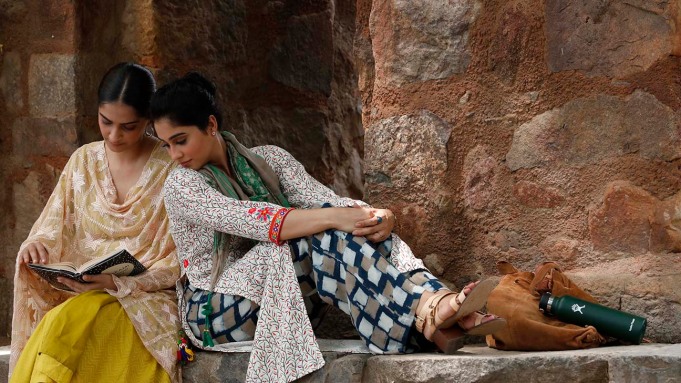
Throughout the storyline various social aspects and norms are themed, such as patriarchal hierarchies within families, family´s expectations of traditional and heteronormative dating, interreligious relationships, homophobia and social acceptance of the LGBTQIA+ community in the Indian context.
Beginning with the character of Babloo as the overcontrolling brother, a patriarchal family hierarchy is shown: he is restricting his younger sister´s sexuality, freedom and life choices by talking down to Sweety and threatening her; he wants to “cure” her by marrying her off to a friend of his.
While trying to escape her brother on her way to the British embassy in Delhi, Sweety meets the theater director Sahil, who helps her run away and immediately falls in love with her. Their ways separate, but Sahil tracks her address down in a supposedly romantic, yet somewhat creepy manner and travels to Moga in Punjab where Sweety lives with her family. Sahil tries to get in contact with Sweety, who is locked in the house by her brother. He doesn’t remain unseen by her family, who is strictly against him dating Sweety, after they find out he is a Muslim and not a Hindu like Sweety.
Traditional, heteronormative and conservative imaginations of dating and marriage come up multiple times in the film, as is already shown by the family´s active role in negotiating a marriage for Sweety and restricting her free choice. Sweety´s father forbids Sahil to marry his daughter, since he believes interreligious marriages cannot work out and lead to complications, while emphasizing at the same time that he doesn’t have any problems with Muslims in general.
As Sahil doesn’t give up trying to win Sweety´s heart, she finally tells him in tears about her being in love with a woman – to which Sahil reacts in insensitive drunk laughter. He apologizes on the next day after realizing his inappropriate reaction and tries to support her by suggesting to produce a local theater play in Moga, which would be about a lesbian relationship and homophobia in society, hoping to raise social awareness and acceptance.
Loneliness and feeling misunderstood as a queer person are portrayed at many points of the film, which enables the audience to grasp Sweety´s helplessness and sadness. Throughout her life she has been misunderstood; she has experienced bullying at school and being an outcast for years, after classmates found her diary with love messages directed to a girl. She thinks that she will never be loved and wishes she could just be “normal”, so that life wouldn’t be so suffocating for her. Sweety´s experiences allow the audience to experience the closeted feeling of hiding oneself and the fear of disappointing one´s family´s and society´s expectations.
Sweety´s relationship with her father demonstrates the fear of disappointing and not being accepted. The father´s character is shown as loving, caring and only wishing the best for his daughter´s future. Yet, he still supports brother Babloo in restricting Sweety´s life and convincing himself that it will be for her best, despite seeing her suffer in silence. As Sweety finally comes out to him during rehearsals for the theater play, he is shocked and shames her for humiliating him and destroying her family´s reputation. Later on, he is conflicted within himself: on the one hand he doesn´t want to accept his daughter being lesbian, yet on the other hand he sees for the first time how sad and lonely she has been in her life while skipping through her diaries.
At the premiere day of the play, the cast, with Sweety and Kuhu as the main characters, is confronted with reactions of homophobia from the audience, as they slowly understand what kind of love story they are seeing. As the first people are leaving and condemning the play for showing a lesbian love story, surprisingly Sweety´s father and brother are showing up, after having rejected Sweety earlier. Seeing his daughter being vulnerable on stage and fighting for her right to love, the fathers view is changing, as his love for her is stronger than his heteronormative expectations. The play comes to an end with a surprisingly heartwarming reaction of the father, positive feedback by the remaining audience and a hopeful ending for Sweety´s and Kuhu´s relationship.
The film shows a well-made lesbian coming out story of courage, love and being true to oneself. The much-needed lesbian and queer visibility shown in this film not only portrays the struggle of LGBTQIA+, but also explores patriarchal norms and gender expectations women are facing in society and in their families. The film is accessible on Netflix and is made well in its acting, music and scenery; it is located in the genre of comedy-drama, which succeeds at making the audience laugh at certain times, and cry at heartfelt moments. With the famous and popular actors Sonam Kapoor, her real-life father Anil Kapoor and Rajkummar Rao, and with music by well-known musicians such as Darshan Raval, Sukhwinder Singh, Arjun Kanungo and many more, the film is a full success and fun to watch.
Nevertheless, there is some critique worth mentioning, as for example the genre of comedy-drama seems to romanticize and play down certain points about Sweety´s coming out and all the complications she has to go through to be accepted by her family. Sweety´s character is also oftentimes portrayed as passive and as being in need for help from her charismatic cis hetero male admirer Sahil. Furthermore the storyline and film would have been more authentic and empowering if the characters of Sweety and Kuhu would have been played by openly queer actresses. I had also hoped to see more about the relationship of Sweety and Kuhu, yet Kuhu barely appears and the movie focuses instead more on Sweety´s family. Moreover, the emotional happy ending seemed even for a comedy-drama film somewhat exaggerated to me, which nonetheless doesn´t make this film in any way less worth seeing or less important. All in all, Ek Ladki Ko Dekha To Aisa Laga is an exciting contribution to queer-lesbian movies and a very much fun and heartwarming film to experience.
About the author:
Lara Kauter is a student of Geographical Development Research (M.Sc.) at Freie Universität Berlin. She holds a bachelor degree in Area Studies Asia/Africa from Humboldt-Universität zu Berlin. Her research interests focus on critical development research, global inequalities, protest movements and gender studies.
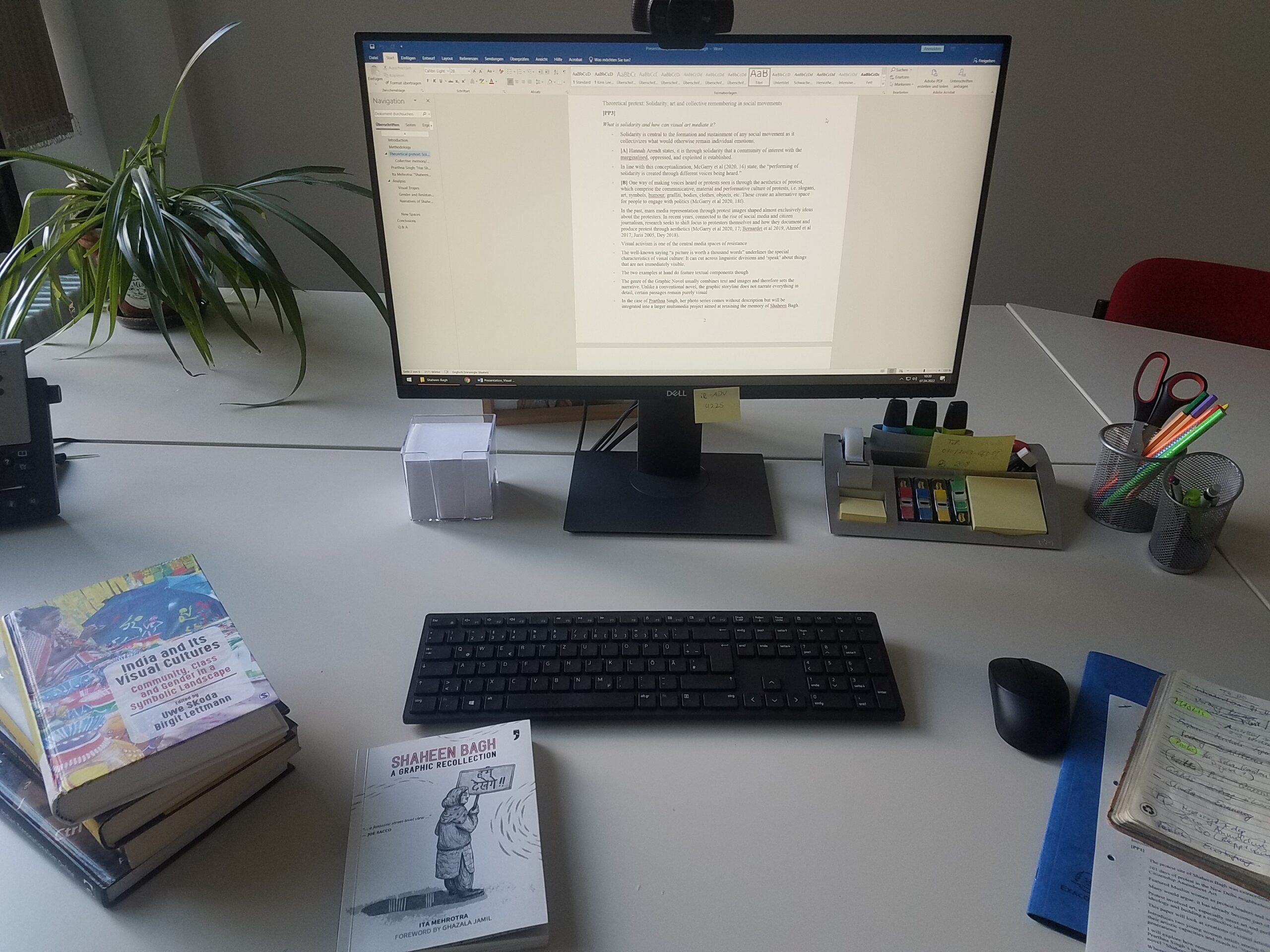
Auf dem Genderblog der HU teilt Dr. Fritzi-Marie Titzmann spannende Einblicke in ihre aktuelle Forschung und zeigt ihren Arbeitsplatz am IAAW, wo sie seit Mai 2021 im Querschnittsbereich Gender and Media Studies for the South Asian Region im BUA-Verbundprojekt RePLITO („Beyond Social Cohesion: Global Repertoires of Living Together“) tätig ist.
Titzmann berichtet von den Hürden der qualitativen Forschung in Zeiten der Pandemie und wie vermeintliche Einschränkungen neue Perspektiven ermöglichen. Sie erklärt, wo sie Motivation für ihre Arbeit schöpft und was sie an ihrem akuellen Forschungsthema der Medienpraktiken indischen Protestbewegungen besonders interessiert. Schwerpunkte ihrer Arbeit sind dabei die Protestbewegung von 2019-20 in Shaheen Bagh, Neu-Delhi, gegen die Einführung eines neuen Staatsbürgerschaftsgesetzes und die Bewegung gegen drei neue Agrargesetze von 2020-21.
Wer mehr über Titzmanns Projekt und Arbeitsweisen erfahren möchte, findet ihren vollständigen Artikel hier.
Dr. Fritzi-Marie Titzmann ist seit Mai 2021 wissenschaftliche Mitarbeiterin im BUA-Verbundprojekt „Beyond Social Cohesion: Global Repertoires of Living Together“ (RePLITO, www.replito.de) und Lehrende am Bereich Gender and Media Studies for the South Asian Region (GAMS) am Institut für Asien- und Afrikawissenschaften der Humboldt-Universität zu Berlin.
Über die Autorin: Elena Schaetz ist Studentin der Afrikawissenschaften (MA) an der Humboldt-Universität zu Berlin. Ihre Arbeitsschwerpunkte sind Literatur, Kultur, Gender und Queerness in südafrikanischen Regionen.
Als ich nach meinem Bachelorstudium drei Monate in Südafrika verbracht hatte, fasste ich bereits im Flieger nach Deutschland den Entschluss, im Rahmen meines Masterstudiums für einen zweiten Aufenthalt zurückzukehren. Mit der Corona-Pandemie, die gegen Ende meines ersten Mastersemesters beginnen sollte, wurde aber schnell klar, dass Auslandssemester und Praktika erstmal nicht wie gewohnt stattfinden können. Mit dem Förderungsprogramm PROMOS des DAAD (Deutscher Akademischer Austauschdienst) werden jedoch auch Forschungsaufenthalte im Rahmen von Abschlussarbeiten finanziert. Unter diesem Thesis-Programm hat man noch gute Chancen, auch in pandemischen Zeiten studienbedingt ins Ausland zu reisen – zumindest, solange die Partner*innen und Institutionen vor Ort einen noch empfangen können und dürfen und die lokalen Einreisebestimmungen eine Reise zulassen. Für die Forschung meiner Masterarbeit passte das gut, mein Thema der queeren Performing Arts in Südafrika mit den Schwerpunkten Spoken Word Poetry, Tanz (speziell Vogueing) und Performance Art ließ mich von Universitäten und Institutionen weitgehend ungebunden forschen. Da ich mein Thema auf das heutige Südafrika beziehe, strebte ich für meine Forschung den direkten Austausch mit Akteur*innen der Szene vor Ort an.
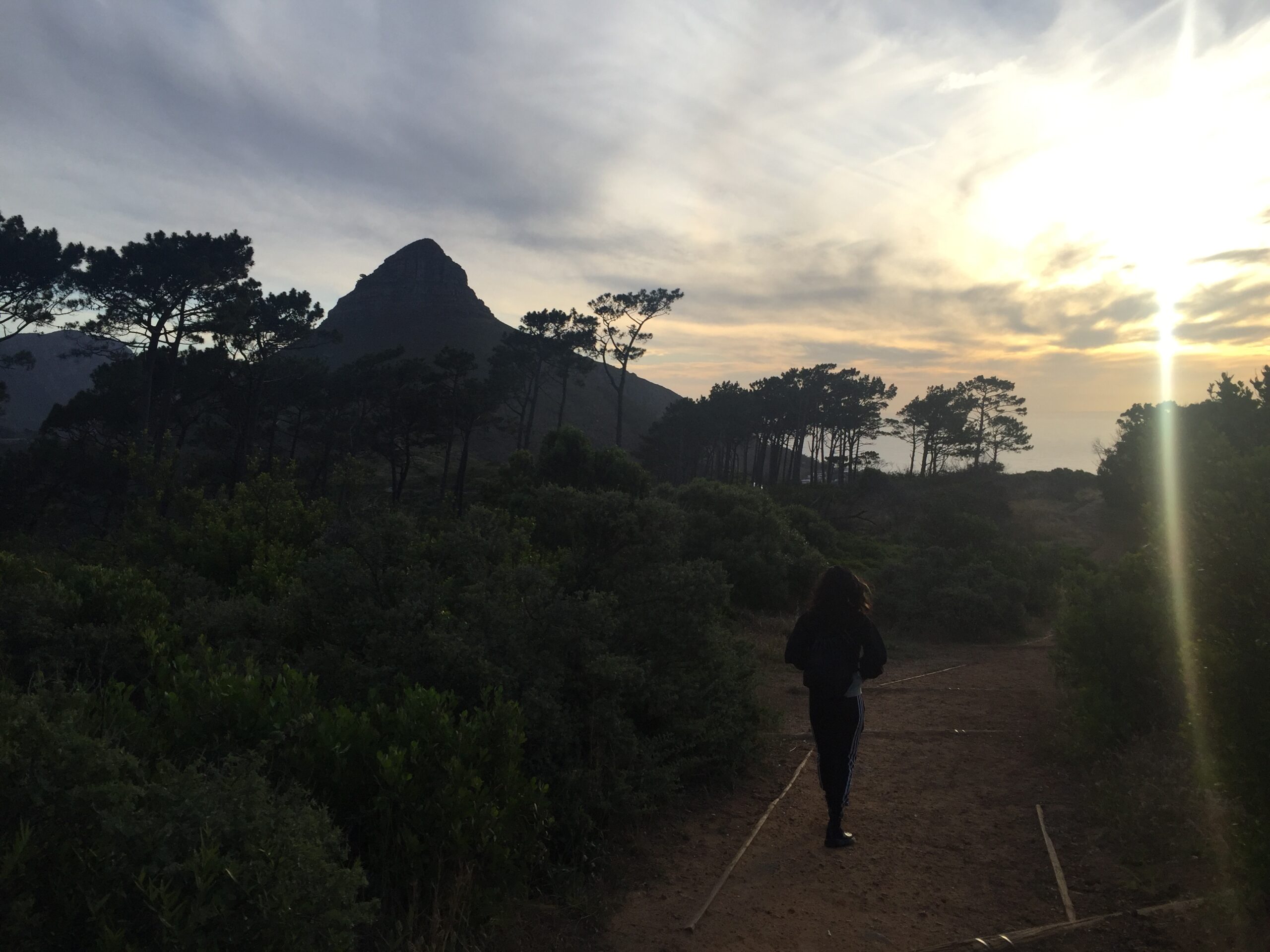
Meine Motivation war es also, mit verschiedenen Künstler*innen in Kapstadt in Kontakt zu treten und diese mithilfe von Leitfadeninterviews zu ihren Erfahrungen, Erfolgen und Kämpfen zu befragen, die sie als queere Personen erleben und durch ihre Kunstform zum Ausdruck bringen. Dabei wollte ich unter anderem erfahren, ob und warum sie ihre Kunst als politisch verstehen, wie ihre queere Identität mit ihrer Kunst zusammenhängt und was ihre persönlichen Beweggründe als Künstler*innen sind. Nachdem mein grobes Konzept samt Fragenkatalog stand, fragte ich die ersten Personen für Interviews an. Mein Wunsch war es möglichst intersektional zu arbeiten, ich wollte ein breites Spektrum von Menschen interviewen, um in viele verschiedene Perspektiven Einblick zu erhalten. Ich musste mir jedoch schnell eingestehen, dass dies nicht so leicht umsetzbar ist. Südafrikanische queere Tänzer*innen, Poet*innen und Performancekünstler*innen, die der Interviewanfrage zustimmten, ließen sich erstaunlich leicht finden – durch meinen letzten Südafrika-Aufenthalt kannte ich noch einige aus der Szene und so ließ sich über Freund*innen und Bekannte schnell ein Netzwerk aufbauen. Weitere Personen fand ich über Instagram, was überaus praktisch war, da die Kommunikation dort in der Regel sehr schnell abläuft und viele Künstler*innen das Social Media Portal als Online Portfolio nutzen, sodass ich direkt einen guten Einstieg in ihre Arbeiten erhielt. Leider wurde meine Liste von Interviewpartner*innen jedoch nicht so divers, wie ich sie gerne gehabt hätte – zwar unterscheiden sich meine Interviewpartner*innen in Aspekten wie dem sozialen Hintergrund, Gender und sexueller Orientierung; was Alter und Race angeht, hatten sie jedoch alle gemeinsam, dass sie PoCs zwischen 20 und 30 Jahre alt sind. Ich hatte auch weiße Personen angefragt, hier jedoch Absagen erhalten.
Nachdem die erste Liste mit Interviewpartner*innen samt Konzept fertig war, schrieb ich meine Bewerbung für PROMOS. Die HU-Beauftragte Frau König war dabei meine Ansprechpartnerin, die mir schnell und zuverlässig bei Fragen und Problemen mit der Bewerbung zur Seite stand.
Ein Problem war beispielsweise, wie kurzfristig das Geld ausgezahlt werden konnte. Dies war der Pandemie geschuldet; da sich die pandemische Lage inklusive eines eingeschränkten Flugverkehrs täglich ändern kann, warteten wir ab, bis es ersichtlich war, dass ich überhaupt nach Südafrika einreisen konnte. So kam es, dass ich keine zwei Wochen vor Ankunft in Kapstadt meine Flüge und Unterkunft buchte.
Bei der Wahl meines Fluges achtete ich darauf, flexibel umbuchen zu können. Eine Unterkunft ließ sich für Kapstadt leicht selber organisieren. Ich wählte ein kleines Apartment im CBD von Kapstadt, um zentral gelegen zu sein und mich flexibel im relativ sicheren inneren Stadtteil bewegen zu können.
Die Durchführung der Interviews war eine spannende Erfahrung, die bis auf die eine oder andere spontane Termin- oder Ortsänderungen meiner Interviewpartner*innen problemlos ablief. Tatsächlich war ich sogar positiv überrascht, wie hilfsbereit die interviewten Personen waren. Oftmals haben sie mich an andere Künstler*innen weitervermittelt, mir interessante Werke und Orte gezeigt, mich auf Performances mitgenommen, mir Veranstaltungen empfohlen und mir wichtige Tipps und Hinweise auch in Fragen der persönlichen Sicherheit als queere Person in Südafrika gegeben, wofür ich sehr dankbar bin.
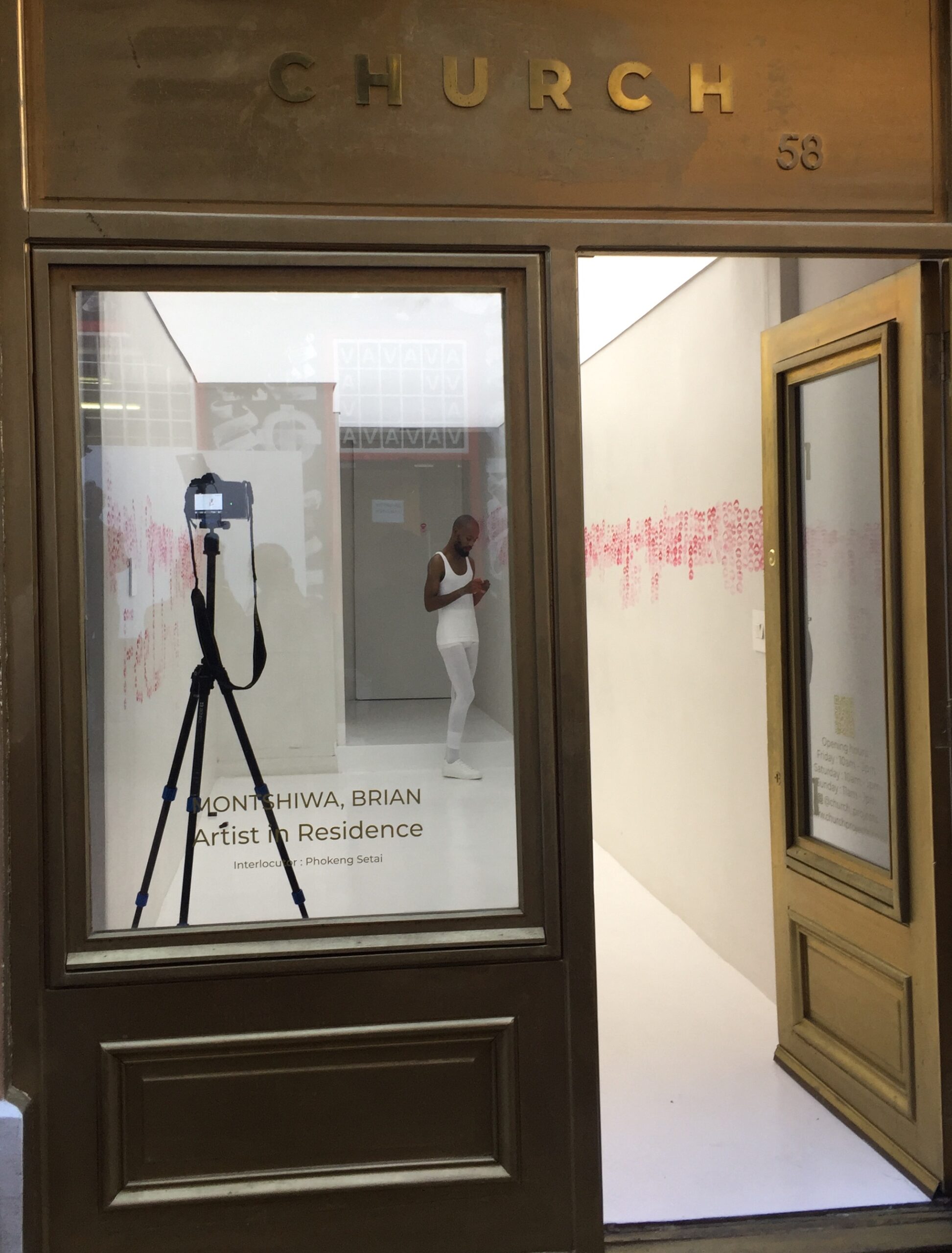
Neben den Interviews habe ich in meiner Freizeit das kulturelle Angebot Kapstadts wahrgenommen, wie beispielsweise die First Thursdays, ein Kunstevent am ersten Donnerstag des Monats, an dem zahlreiche Galerien in der Church und Bree Street kostenlos öffnen und sich die Stadt abends zum Ausstellungs-Hopping trifft. Das noch relativ neue Kunstmuseum Zeitz Museum of Contemporary Art Africa an der Waterfront ist auch ein Muss, ebenso die Stevenson Gallery, in der Zanele Muholis fantastische Kunst ausgestellt wird.
Die derzeitige Pandemie hatte aber natürlich auch Einfluss auf meinen Aufenthalt. Kurz vor meiner Abreise erkrankte ich selbst, zum Glück jedoch nur recht leicht, sodass ich eine Quarantäne-Unterkunft problemlos organisieren konnte und die weiteren Schritte einzuleiten wusste. Im Nachhinein denke ich, dass es sinnvoll gewesen wäre, schon vor Beginn der Reise eine Art Notfallplan zu erstellen, um dann besser handeln zu können. Ich denke, jede*r sollte sich bewusst sein, dass Reisen, speziell Fernreisen, während einer Pandemie ein Risiko mit sich bringen, von einer möglichen Erkrankung, plötzlich eintretenden Flugverboten, bis hin zu erschwerten Arbeitsweisen. Ich hatte ursprünglich auch einen Kurztrip von Kapstadt nach Johannesburg für weitere Interviews organisiert. Nachdem genau in der Provinz von Gauteng die neue Virusvariante Omikron entdeckt wurde, plante ich jedoch schnell um, sagte die Präsenzinterviews dort ab und wechselte mit diesen Personen auf ein Online-Format, was natürlich sehr schade war. Bei Forschungsreisen in diesen Zeiten halte ich es jedoch für notwendig, diese Flexibilität zu haben und ein paar Schritte vorauszudenken – was tue ich, wenn Veranstaltungen spontan abgesagt werden müssen, Reisen innerhalb des Landes verboten werden oder eine große Zahl meiner Interviewpartner*innen krank werden oder in Quarantäne sind? In meiner Arbeit hatte ich durch die Interviewform die Möglichkeit, Termine innerhalb meines Aufenthaltes zu verschieben oder im Notfall online zu legen, dies musste ich zum Glück nur bei den Interviews mit den Johannesburger Künstler*innen wahrnehmen. Dass ich alle Interviews in Kapstadt vor Ort durchführen konnte, war ein großes Glück und riesiges Privileg, was ich sehr zu schätzen weiß.
Mein Forschungsaufenthalt in Kapstadt ist definitiv ein prägendes Highlight meines Masterstudiums, an dieser Stelle noch einmal herzlichen Dank an PROMOS, den DAAD und an Frau König aus der Vermittlungsstelle der HU. Es war eine lehrreiche Erfahrung, selbstständig meine Arbeit zu organisieren, mit spannenden Personen in den Dialog zu treten und meine Forschung zu vertiefen. Dementsprechend wünsche ich jeder Person, die einen solchen Aufenthalt gerne absolvieren möchte, die Chance dazu.
Über die Autorin: Elena Schaetz ist Studentin der Afrikawissenschaften (MA) an der Humboldt-Universität zu Berlin. Ihre Arbeitsschwerpunkte sind Literatur, Kultur, Gender und Queerness in südafrikanischen Regionen.
Nadja-Christina Schneider
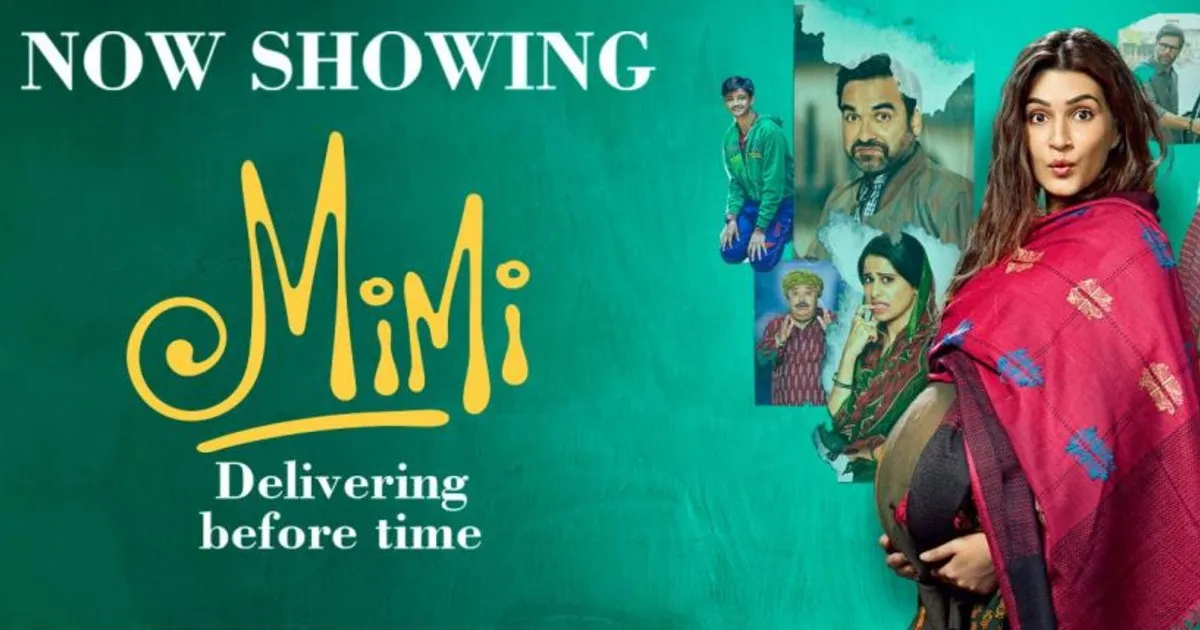
Mimi (2021, dir. Laxman Utekar) is not the first remake of the 2011 Marathi feature film Mala Aai Vhhaychy! (“I want to be a mother”), directed by Samruoddhi Porey. In 2013, a Telugu remake by director Singeetam Srinivasa Rao was released under the title Welcome Obama. Single persons, same-sex and unmarried couples from abroad had already been excluded from legal access to surrogacy in India before the complete ban of commercial surrogacy in 2016. This may partly explain why in the Hindi remake Mimi, it is not a single woman from the United States who commissions the surrogacy, unlike in the Marathi original. Rather, it is now an involuntarily childless married couple who are nevertheless conveniently able to contribute the necessary gametes themselves – sperms, egg cell – on site so that the fertilized egg can then be transferred to Mimi’s uterus in a specialized clinic in Jaipur. Mimi had never planned on becoming a gestational mother but the experience of becoming a mother will change her life forever.
Read the whole article on Doing Sociology: https://doingsociology.org/2022/01/05/becoming-an-altruistic-mother-mimi-now-streaming-on-netflix-and-jio-cinema-but-why-exactly-now-nadja-christina-schneider/
By Alice Picco, October 15th, 2021
“My voice is loud because there are not many voices.”
Growing up queer is certainly something that shapes your whole life. Especially in your younger years, discovering and accepting your own queer self might not be easy at all. Young queer people often feel alone, misunderstood and left out, and not everyone is lucky to live in a queer-friendly environment or have supportive families. This is the main reason why I chose to interview Kai Mata for my research project: her activism relies on the concept of “being who you needed when you were younger.” Kai Mata is an Indonesian singer/songwriter and an openly queer activist. She has chosen to make her queerness an important part of her artistic and musical production and uses social media to spread awareness on LGBTQ+ issues in Indonesia. Kai Mata has an Instagram account of nearly 6K followers, of which the bio reads “Indonesia’s openly LGBTQ+ musician.” In her account, we see the co-existence of her international fanbase as well as her attention to Indonesian issues and language. The captions to her Instagram posts and the subtitles to her videos are often both in English and in Indonesian, and there are numerous references to events or policies happening in Indonesia. However, the contents Kai Mata creates and the way she expresses herself are very international. As we will see, Kai’s primary activist strategies include re-appropriation of counternarratives and the use of recurrent visual symbolism.
Together with the interesting network of queer Indonesian activism and the historical peculiarities of the country’s views and policies on gender and sexuality, Kai Mata’s activism strategies interested me because of their ability to reach a wide audience, both Indonesian and international. Being a queer person myself, I too have struggled with both self and external acceptance. I often think about other peoples’ stories when it comes to acceptance, coming out and participation in queer activism.
The experience of queerness varies in different settings and backgrounds. These settings can change the way in which queerness expresses itself and the challenges queer individuals might face. How can a queer person’s story develop, according to the environment they live in? How does having a support network of organizations or familiar/peer support influence queer people’s lives? Having all these questions in mind, I decided to conduct a study that combines Kai Mata’s personal story and her activism strategies.
To conduct my research, I focused on digital techniques of communication, social media representation and data analysis of Instagram reels and posts. My digital ethnography also included Kai Mata’s music and video content. Since Kai Mata’s communication technique combines her career as a singer and musician with her activism, her musical work is explicit and unapologetic in explaining queer struggles and defending queer rights. Along with the cover tracks, Kai Mata’s music is explicitly directed at an LGBTQ+ audience. The song “So Hard” for example, explicitly refers to the struggles of queer women in heteronormative society. The main resources utilized in this study are the audio recording of the zoom interview I had with Kai Mata and her Instagram account, in particular the reel “Reaksi 🏳️🌈 Lesbi Terhadap ‘Bahaya LGBT’”.
I conducted my research along two main lines of inquiry. My first aim was to analyse the figure of Kai Mata biographically in terms of her story, what it meant for her to grow up in Indonesia, how and when she started her career and her activist activity, and what were the challenges she encountered. The second part of my research focused on online communication, social media and digital activism.
I loved conducting the interview because I instantly felt like Kai Mata enjoyed speaking about her career and activism, which definitely helped me to come up with new questions spontaneously.
When asked for her definition of “queer” and what this term means to her, she replied:
I think “queer” for me… Is my sexual orientation, is the identity that my love isn’t bounded by gender and that I am open to loving people of various sexual orientations and gender identities.
Kai Mata argues that “queer” encapsulates all kinds of sexualities, whereas terms like “gay” or “lesbian” may be limiting. She adds that she stopped identifying as gay or lesbian because she wants people to know she is not referring only to cisgender people: she argues that she is able to love people of various genders. Kai Mata specifies that although she identifies as queer, she would never call someone else queer, since it was used as a derogatory term in the past. Kai Mata argues that to some people, especially the elders, the term queer could still hold emotional value. Therefore, it is better not to use it unless someone uses it for themselves.
When I asked her about her about growing up in Indonesia, she told me about the discovery of her sexual orientation. She told me how she had trouble admitting to herself or other people that she was in love with a girl, how she felt confused, scared and alone. She felt like she had no one she could talk to. Kai Mata describes coming to terms with her sexuality while living and growing up in Indonesia as one of the most significant experiences of her life and thus inevitably present in her song writing. For this reason, the concept of “being who you needed when you were younger” is a recurring idea in Kai Mata’s activism strategy. She has taken on the mission to get into contact with young LGBTQ+ people coming out for the first time, and put them in touch with Indonesian LGBTQ+ networks.
When speaking about queer activism in Indonesia, what emerges from the interview is that although there is a variety of Indonesian LGBTQ+ networks, most of these operate underground. Kai Mata always highlights how she is grateful she has an international fanbase, but her focus is mainly on Indonesian issues: “Here is where I’m more present, because here is where I’m needed the most.”
Another prominent aspect of Kai Mata’s communication on social media platforms is that of the focus on Indonesian issues and problems, together with references to Indonesian tradition and diversity. In the interview, for example, she explained that she could move to the US or a European country and live a more relaxed life, face less backlash and continue her music and activism career without having to worry – or worry less – about homophobic attacks. Although her communication strategies and her audience are largely international, she has a strong focus on Indonesian issues, and a strong sense of belonging to Indonesia. She stays in Indonesia because while she has the possibility of moving, other people don’t have this possibility. Kai acknowledges that the critique that could be directed to her activism is related to her coming from privilege. Not every queer person in Indonesia would want the degree of exposure that she has; “visibility” does not sound like a promising perspective for everyone. Some would feel in danger with increased visibility, others would feel uncomfortable, and again others would just not be interested in sharing their sexual preferences with the world.
A recent example that illustrates Kai’s online activist strategy is her Instagram reel “Reaksi 🏳️🌈 Lesbi Terhadap ‘Bahaya LGBT’”. This reel is an example of Kai Mata’s visibility techniques to counter homophobic attacks and backlash. In fact, it is meant to be a reply to an offensive and homophobic video of a song saying “lesbians are singing” which displayed the “dangers of the LGBT”. This video was sent to her, challenging Kai Mata to reply to the backlash. She did so with her own version of the song.
When confronted with the video “Bahaya LGBT” and asked to respond to it, Kai Mata said: “despite the fact that is mocking us and saying that we don’t deserve the right to be legal, it kind of sounds like a queer anthem”. The re-appropriation of counternarratives is an effective way to respond to this kind of internet backlash. Kai Mata uses the offensive parody to create a musical celebration of being LGBTQ+: “Lesbians are singing, transgender women are dancing. Because we are happy, proud to be LGBT.”
This celebratory song Kai Mata has composed is useful to understand her focus on Indonesian issues and her attention to Indonesian history and culture. Hereby, she mentions Indonesian diversity and tradition and states the contradiction between the country’s history and its current policies (such as conversion therapy):
So come take a look at the culture of our country: the Bugis tribe tradition, the Lengger’s tradition…if this makes you alarmed, remember our nation’s motto: “Unity in Diversity”. Rainbows also shine in our skies, don’t forget the 5th principle of our nation’s philosophy: “Social Justice for all Indonesians”.
Her communication strategy focuses on re-appropriating backlash and homophobic attacks and responding to them with positivity. Positivity, re-appropriation, and visibility form key parts of Kai’s activist strategy. For example, she relies heavily on the use of symbols like the LGBTQ+ flag.
She frequently uses this symbol both in the photos she posts, as well as in emoji form on her Instagram account. She also had a small pride flag on her desk when I interviewed her. Kai Mata argues that she uses the pride flag as a mean of representation:
I wear rainbow paraphernalia in hopes any queer individuals around recognize they are not alone. When I was first accepting the fact I wasn’t straight, I had no idea queer Indonesian women existed. It felt isolating and lonely. So now, I use the rainbow socks or mask to showcase to any LGBTQ+ individuals walking down the street that there is someone around that may relate to them, and that their sexual/gender identities do not need to isolate them.
In her perspective, the rainbow flag serves as a means to visibility and a reminder of pride. Coming from left-wing queer-punk activism in Italy, this aspect was especially interesting for me personally. In my particular context, the use of rainbow paraphernalia is often associated with rainbow-capitalism and companies appropriating queer culture. Visually, queer-punk activism tends to use the classic aesthetics of punk combined with the colours red and pink. The use of rainbow colours has actually become more diffused in mainstream communication during the last years, for example when companies started creating limited edition “pride” product lines.
In the context of Indonesia, however, Kai uses the rainbow flag to be recognizable to people who – for many reasons – are not comfortable openly expressing their sexuality. This shows that the experience of queerness varies from context to context, together with the necessities and strategies of representation as well as the mechanisms of recognition between queer individuals.
Kai Mata’s persona and music are part of a wider trend of the increasing popularity of online community building and activism. Especially since the start of the pandemic, the internet has substituted public spaces in creating and expanding networks. When we talk about LGBTQ+ activism, we talk about networks of care: connections that can help people struggling with their sexuality to find someone they can talk to and receive emotional and material assistance, without necessarily having to meet in person. Some of the most prominent associations in Indonesia are GAYa NUSANTARA and Arus Pelangi. These networks often help young queers with any kind of emergency that can occur in coming out in a non-accepting environment, such as housing or financial problems. Kai Mata is often contacted by these young LGBTQ+ individuals, and helps them to get in touch with these networks.
Through this research, I discovered that it is possible to conduct an ethnography without necessarily being physically present on the field. Digital and social media technologies can also help create networks of aid and care that go beyond physical distance, as Kai Mata explains when she speaks about young queers needing housing or financial help.
One of the most interesting aspects that is present in Kai Mata’s communication strategy is that of the re-appropriation of counter narratives, as seen on the reel where she replies to backlash in a “positive” way. Re-appropriation is something very prominent and discussed in the queer community, especially when it comes to slurs and derogatory terms. Furthermore, her social media strategy emphasises visibility and visual symbolism, and has a decidedly international outlook – evidenced by for example her repeated use of the rainbow flag, and her use of both English and Indonesian language.
I would like to thank Kai Mata for wanting to share her story with me and help me with this project. This research has been an interesting moment of reflection on the struggles of the LGBTQ+ community in Indonesia, as well as the caring networks and activist strategies that can be cultivated on social media.